
You, as a marketer, must be familiar with this scenario: someone is scrolling their feed rapidly, and your ad creative has less time than you think to make an impact. That’s true. The modern-day audience has the lowest attention span ever. You have only 1.5 seconds to catch their eye, stop them mid-scroll, and make them pay attention. Otherwise, your message can get lost in the noise.
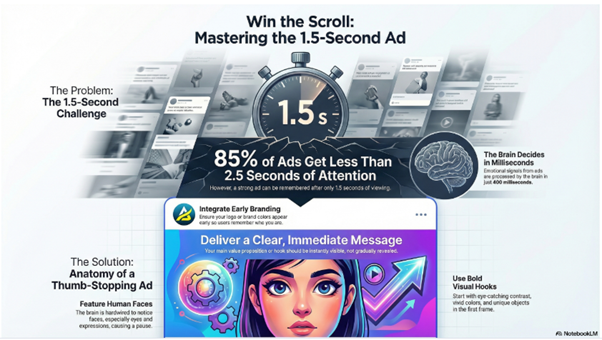
This isn’t guesswork. Recent studies have proved that digital ads get less than 2.5 seconds of attention. But ads can be remembered after as little as 1.5 seconds when they use clear, distinct branding and smart design.
Let’s find out what makes a creative thumb-stop (something that stops people scrolling), why it is important, and how you can improve the performance of your ads in that small window of time.
Why the First 1.5 Seconds Matter
Imagine the speed at which individuals scroll through social feeds. Your ad creative may be there for a moment in that race. This is because what occurs at that point will make or break someone’s scroll.
In a research titled Hacking the Attention Economy, 85 per cent of online advertisements received less than 2.5 seconds of active time. Nonetheless, even ads with strong visual branding can be recalled after only 1.5 seconds of attention.
It simply means that attention is your gateway to impact. If you get that attention quickly, you are likely to get more people to click, make your brand easy to recall, and eventually encourage the viewers to make a purchase. Great ad creative is more than just aesthetics. It’s the part of the ad that earns attention first.
What “Thumb-Stopping” Really Means
A thumb-stopping creative interrupts the scroll of a viewer.
It grabs attention fast and clearly communicates something that makes the viewer stop scrolling. Maybe that could be emotion, curiosity, surprise, or relevance.
Platforms like Meta and TikTok have internal benchmarks saying creatives need impact almost immediately to count. Unless your design captures the viewers’ attention in a short time, none of the other things that you do (targeting and copy) will work as effectively.
It means that your ad creative should:
- Demonstrate something significant immediately.
- Make the viewer feel something or ask a query.
- Use visuals that stand out among many images.
The Science of Rapid Attention.
What is so important about the first 1.5 seconds? It comes down to how human attention works.
At approximately 400 milliseconds, the brain begins to process a large number of ads and sends emotional signals, as found by one study. After a bit more time, these signals become memories or evaluations of the content.
This fact indicates that the brain does not wait. It makes swift decisions on the worth of something to pay attention to. Therefore, creators who are able to convey their central message in the shortest time possible have a better chance of being recalled.
In addition, images are processed much quicker than words. The brain picks up images and high-impact visuals more than paragraphs of words. That is why powerful images have higher chances of making people scroll.
Major Components of Thumb-Stopping Creatives.
Here’s what the best creatives are likely to do differently to work fast and successfully.
Bold Visual Hooks
The initial frame of the image or video should be eye-catching. Make use of contrast, vivid colours, and objects that are not the regular feed background.
Faces and Human Elements
The human face is a strong visual signal. The brain is wired to notice faces, particularly eyes and expressions. If you have a human face at the forefront in your ad, it will more likely get a pause.
Clear First Message
Your main idea needs to be visible right away. That could be a provocative title, an emotional visual, or a promise of value. Do not conceal your message with a big intro or gradual build-up.
Simple Design
Keep the design simple and easy to comprehend. Excessive details or clutter will confuse the viewer within a small fraction of time. Basic images are easier to process by the brain.
Early Branding
The logo and colours of the brand must be there in the creative. If your brand isn’t obvious, people might remember the idea but not who delivered it.
Movement and Motion
Motion can be used intentionally in video ads. Attention can be enhanced by a slow entry animation or a fast action during the first moment. However, caution is needed: excessive movement may overpower the audience.
Formats That Perform Well
The short-form video content has become a staple for attention-grabbing creatives. The video formats, such as Instagram Reels, TikTok videos and vertical stories, are inherently more advantageous as they take up the entire screen and do not look like advertisements.
Static formats can still work, though. Even a single still image of emotion, surprise, or a big idea can be as effective. The key is clarity and impact.
The following are what the best creative formats have in common:
- Short-term attention to the value or message.
- Minimal distractions
- Close correspondence with the interests of the audience.
Testing and Measuring Creative Success
You cannot measure what you do not optimise. Evaluate metrics of attention, not necessarily clicks. For example:
- Thumbstop ratio: the number of viewers who do not scroll past the first seconds.
- Short video view-through rates.
- Click-through rates (CTR).
- Interactions such as likes, comments, shares.
Platforms like Meta and TikTok provide data on how long viewers stay with a creative and how they interact. Use these signals to refine creatives over time.
Learning from Winning Creatives
To put your ideas into practice, the following are practical tips applied by successful creatives:
Use Contrasting Colours
Bright colour that stands out against the background of the platform (such as a bright yellow on a mostly white feed) is immediately noticeable.
Talk to Your Audience in Their Language
Your advertisement must be more of a message to an individual than a general, mass pitch. Meet their needs immediately.
Tell a Mini-Story Fast
Even in 1.5 seconds, you can hint at a story: a problem + solution or before/after. That’s enough to spark curiosity and keep someone watching.
Test Variations
Test various hooks, colours and headlines. The slightest adjustments during the initial instance can result in enormous performance changes.
The Bottom Line
It is an uphill task to get your creatives noticed by the viewers in this age of rapid scrolling. If your creatives fail to capture attention within 1.5 seconds, they never exist. However, with visual appeal, clarity, relevance and good branding, even those few seconds can be a long-lasting impression that will lead to actual outcomes. Keep in mind, it is not only about being seen. It is a matter of being remembered and seen.