Running a small agency in 2026 can feel like trying to do the work of five departments with the resources of one. You have clients to manage, campaigns to plan, content to create, reports to prepare, leads to follow up with, meetings to attend, invoices to track, and deadlines that somehow always arrive at the same time. The good news is that you no longer need to handle every repetitive task manually.
AI automation has moved beyond simply asking a chatbot to write an email or generate an idea. Today’s tools can connect with business applications, organise information, create content, analyse data, trigger workflows and even complete certain tasks automatically.
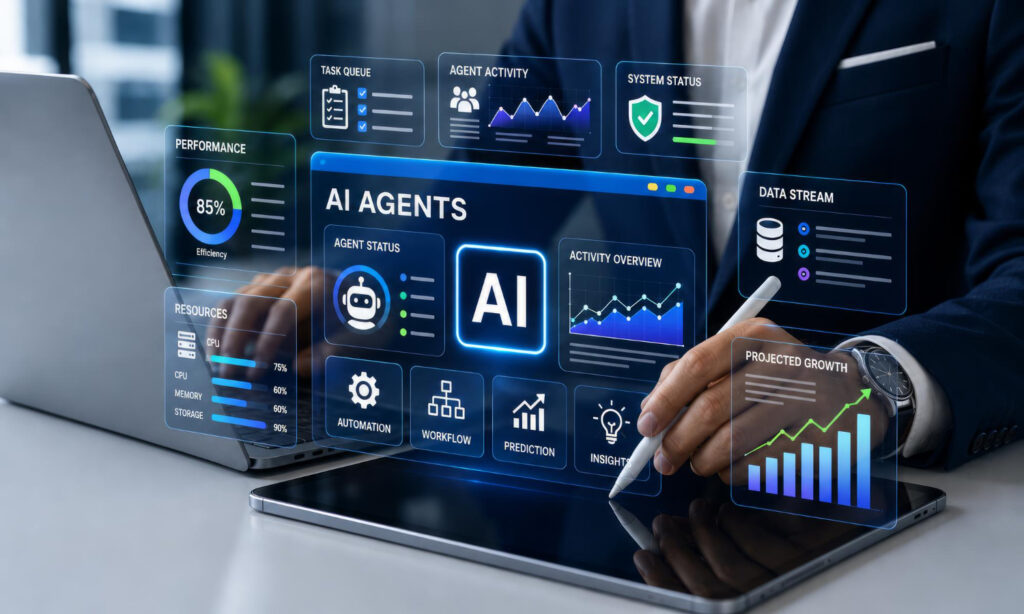
“The goal of AI automation isn’t to replace the agency team. It is to give a small team the operating power of a much larger one.”
But that does not mean an agency needs 30 different AI subscriptions. A better approach is to build a simple AI tech stack where every tool has a clear job.
What Is an AI Automation Tech Stack?
An AI automation tech stack is the combination of software your agency uses to manage and automate its daily operations.
For a small agency, this could include tools for:
- AI research and writing
- Project management
- Customer relationship management
- Design and content creation
- Workflow automation
- Reporting and analytics
- Meeting notes
- Customer communication
- Lead management
The objective is not to automate everything. The objective is to automate the repetitive work that takes time but does not require constant human judgement.
1. AI Assistant: ChatGPT or Claude
Every small agency needs a reliable general-purpose AI assistant. Tools such as ChatGPT and Claude can support research, brainstorming, content development, summarisation, analysis, documentation and repetitive knowledge work. Claude’s 2026 small-business offering, for example, is designed to connect with tools businesses already use and support end-to-end workflows rather than functioning only as a chatbot.
An agency could use an AI assistant to:
- Turn meeting notes into action items
- Create first drafts of proposals
- Summarise research
- Generate content ideas
- Analyse spreadsheets
- Create campaign variations
- Develop content briefs
- Draft client emails
- Create internal SOPs
However, AI should remain an assistant, not the final decision-maker. Client-facing content, strategy, claims, numbers and recommendations should still be reviewed by a human.
2. Zapier: Connect Your Tools
One of the biggest problems inside a small agency is that information lives in different places. A lead may arrive through a website form. The sales team may use a CRM. The project team may work in another application. Client communication may happen through email or Slack. This is where Zapier can become the connection layer. Zapier currently supports more than 9,000 app integrations and allows businesses to create workflows that connect applications, data and AI models.
For example:
Website form submission → CRM → Slack notification → Follow-up email → Task creation
Instead of an employee manually moving the same information between systems, the workflow handles the repetitive steps. Zapier also provides AI-powered workflow-building and troubleshooting features, making automation easier for teams that do not have extensive technical expertise.
3. HubSpot: Manage Leads and Client Relationships
For agencies that handle multiple leads and clients, a CRM can become the centre of the sales process.
HubSpot can help agencies organise:
- Contacts
- Leads
- Deals
- Customer interactions
- Emails
- Marketing activity
- Sales pipelines
- Follow-ups
Its current AI ecosystem can also bring CRM context into AI tools such as ChatGPT, Claude and Gemini, allowing teams to analyse customer information and take certain CRM actions through AI-supported workflows. For example, instead of manually reviewing dozens of CRM records, an agency could use AI to identify leads that have not received a follow-up recently.
That turns CRM data into an actionable workflow.
4. Canva: Create Content Faster
Design remains a major part of agency work. Social media posts, presentations, advertisements, client reports and campaign graphics all require visual content. Canva’s AI capabilities can help agencies speed up the process of turning ideas into editable designs. Its AI connector now allows Canva to work directly with AI assistants such as ChatGPT and Claude, including generating editable designs, searching existing content and adapting designs for different formats.
A simple workflow could look like:
Campaign brief → AI generates concepts → Canva creates editable design → Human designer reviews → Final asset
This does not eliminate the need for creative professionals. Instead, it reduces repetitive production work and gives designers more time for creative direction and quality control.
5. Notion: Build Your Agency’s Knowledge Base
Small agencies often have an invisible problem: knowledge lives inside people’s heads. One employee knows how a client likes reports. Another knows the campaign process. Someone else remembers the exact steps for publishing a website. Notion can help turn this information into a central knowledge system.
An agency can use it for:
- SOPs
- Content calendars
- Client information
- Meeting notes
- Project documentation
- Internal guides
- Campaign planning
- Onboarding
The more organised your internal information becomes, the more useful AI becomes. AI works best when it has access to clear, structured context.
6. Meeting AI: Turn Conversations Into Action
Agency meetings can generate valuable information, but manually writing notes and action items takes time. AI meeting assistants can transcribe conversations, summarise discussions and identify tasks. Instead of someone spending 30 minutes writing:
“Client requested three changes to the campaign…” the system can generate a summary and action list. The team can then focus on doing the work rather than documenting every conversation manually. This is particularly useful when an agency has multiple client meetings every week.
7. AI-Powered Reporting and Analytics
Reporting is another area where agencies can save significant time. Instead of manually collecting data from multiple platforms every month, automation can bring information into a central reporting system.
AI can then help answer questions such as:
- Which campaigns performed best?
- Which traffic sources increased?
- Where did conversions decline?
- Which content generated the most engagement?
- What should we test next month?
The important distinction is that AI should help interpret the data, not simply create attractive reports. A beautiful dashboard with the wrong conclusion is still a bad report.
8. AI for Content Repurposing
One piece of agency content can often become multiple assets.
For example:
One webinar
can become:
- 5 short videos
- 3 LinkedIn posts
- 1 blog
- 1 email
- 10 social media hooks
- 1 carousel
- 1 client newsletter
AI can help with the transformation process. The agency team still decides what is valuable, accurate and on-brand. This creates a much more efficient content production system.
Detailed Example: How a Five-Person Agency Could Automate Its Workflow
Imagine a five-person digital marketing agency receives a new lead through its website.
Before automation, the process looks like this:
- The sales employee receives the form.
- They copy the information into the CRM.
- They send a notification to the team.
- Someone creates a task.
- Another employee prepares a proposal.
- After the meeting, someone writes notes.
- The account manager manually creates the project.
- The process may involve several small tasks that individually take only a few minutes.
Together, they consume hours every week. Now build an automated workflow.
Step 1: Lead Arrives
A prospect submits the website enquiry form.
Step 2: Automation Starts
Zapier sends the information directly into the CRM.
Step 3: Team Notification
The sales team receives a Slack notification containing the lead’s basic information.
Step 4: Lead Classification
AI analyses the enquiry and categorises it based on factors such as service requirement, company type and urgency.
Step 5: Follow-Up
A personalized first-response email is drafted using the information provided by the prospect.
A team member reviews and approves it.
Step 6: Meeting
The prospect books a meeting.
An AI meeting assistant creates notes and identifies action items.
Step 7: Proposal
The AI assistant uses the meeting notes to create a first proposal outline.
The strategist reviews the strategy, pricing and recommendations.
Step 8: Project Creation
Once the deal is approved, the workflow creates the project, assigns tasks and stores the relevant information.
The result? The agency has not removed humans from the process. It has removed unnecessary copying, searching, typing and repetitive administration. That is where AI automation creates real value. AI automation is transforming how businesses manage repetitive marketing tasks, from content creation and customer communication to data analysis and campaign optimisation. To explore how these technologies can improve efficiency and marketing performance, see iSonic Media’s guide to AI in Digital Marketing and Automation Tools
Don’t Build an AI Stack Just Because a Tool Is Trending
One of the biggest mistakes agencies can make in 2026 is collecting tools instead of building systems. You don’t need:
20 AI tools + 10 automation platforms + 5 dashboards.
You need a small number of tools that work well together.
Start by asking:
What repetitive task consumes the most time every week? Then automate that task first. After it works reliably, move to the next one. This approach is safer, cheaper and easier to manage.
Why Choose iSonic Media?
Choosing the right technology is only the beginning. The real value comes from knowing how to connect technology with your marketing goals. At iSonic Media, we combine digital strategy, creative thinking, technology and performance-focused marketing to help businesses build stronger digital systems. Whether you need SEO, social media marketing, web development, paid advertising, analytics or a more connected digital strategy, our approach focuses on your actual business objectives rather than simply adding more tools to your stack. The goal is simple: use technology to make your marketing more efficient, measurable and scalable Ready to make AI and automation part of your agency’s growth strategy? Talk to iSonic Media about building a practical digital and automation strategy around your business. Instead of asking, “Which AI tool should we buy?”
start with: “Which part of our business should work smarter?” That is where your 2026 tech stack should begin.